


Comparable sales—or "comps"—are recently sold properties with similar characteristics to a subject property. Agents and appraisers use comps to determine fair market value by analyzing what buyers actually paid for similar homes, land, or commercial properties. Without accurate comps, you're pricing blind.
The cost of mispricing a listing is steep. Price too high, and your listing sits—accumulating days on market while buyers question what's wrong with it. Price too low, and you leave money on the table, losing your client's trust (and future referrals) in the process. According to the National Association of Realtors, homes priced correctly from day one sell faster and closer to asking price than those that require price reductions.
This guide walks you through exactly how to find comps for real estate, step by step. You'll learn where to source comp data, how to analyze it, what adjustments to make, and which tools can cut your research time from hours to minutes. Whether you're pricing a suburban home or a 200-acre rural parcel, these methods apply.
What Are Comparable Sales?
Comparable sales are recently closed transactions for properties that share key characteristics with the property you're trying to value. They form the foundation of every Comparative Market Analysis (CMA) and are the primary evidence appraisers use to justify their valuations.
Think of comps as market proof. When you tell a seller their home is worth $425,000, comps answer the inevitable follow-up: "How do you know?" They shift the conversation from opinion to evidence.
Who uses comps:
- Real estate agents use comps to price listings, advise buyers on offer amounts, and build CMAs that win listing presentations
- Appraisers are legally required to use comps to support their valuations for lenders
- Investors and developers use comps to underwrite deals, justify offers, and present acquisition cases to partners
- Property owners use comps to understand their equity position or contest tax assessments
The better your comps, the more defensible your pricing recommendation. And the faster you can pull them, the more competitive you become.
Key Factors That Make a Property "Comparable"
Not every recent sale qualifies as a comp. The properties must be similar enough that a buyer would reasonably consider them substitutes. Here are the primary factors that determine comparability:
Location
Location is the single most important factor. A comp should be in the same neighborhood, subdivision, or market area as your subject property. For residential properties, appraisers typically look within a one-mile radius in urban areas and up to five miles in rural areas. For vacant land, comparable location also means similar access to roads, utilities, and amenities.
Property Type & Use
The comp should be the same property type. A single-family home should be compared to other single-family homes, not condos or townhouses. Vacant agricultural land should be compared to other agricultural parcels, not residential lots.
Size
For homes, compare square footage. For land, compare acreage. Ideally, comps fall within 10–20% of the subject's size, though this range widens in rural areas where inventory is limited.
Age & Condition
A newly built home isn't directly comparable to a 1960s ranch without significant adjustments. Look for properties of similar vintage and condition—updated kitchens, roof age, and overall maintenance level all factor in.
Sale Date
Comps should be recent. For active markets, three to six months is ideal. In slower or rural markets, you may need to extend to 12 months. Sales older than a year require careful adjustment for market appreciation or depreciation.
How to Find Comps for Real Estate: Step by Step
Finding quality comps requires checking multiple sources. No single database has complete coverage, especially for rural and land properties. Here's the systematic approach professionals use:
Step 1: Define Your Search Criteria
Before you search anywhere, establish your parameters based on the subject property:
- Property type: Single-family, multi-family, vacant land, commercial
- Location radius: Start tight (0.5 miles for urban, 3 miles for rural) and expand if needed
- Size range: Plus or minus 20% of subject's square footage or acreage
- Sale date range: Start with six months; extend to 12 if necessary
- Price range: Optional, but helps filter outliers
Write these down. You'll apply the same criteria across every source to maintain consistency.
Step 2: Search the MLS
The Multiple Listing Service remains the most comprehensive source for residential comps in most markets. If you have MLS access, start here.
MLS strengths:
- Most complete data on listed and sold residential properties
- Includes photos, days on market, price history, and agent remarks
- Standardized data entry makes comparison easier
MLS limitations:
- Coverage gaps for rural properties, vacant land, and off-market sales
- Data quality depends on listing agent input
- No access for unlicensed investors or out-of-area agents without reciprocity
How to search effectively:
- Use the "sold" or "closed" filter, not active listings
- Set your defined parameters (location, size, date range)
- Sort results by sale date (most recent first)
- Export or save the five to 10 closest matches for analysis
Step 3: Check County Records
County assessor and recorder offices maintain official records of all property transfers—including sales that never touched the MLS.
County records strengths:
- Captures every recorded sale, including off-market and FSBO transactions
- Often includes deed type, sale conditions, and buyer/seller names
- Free or low-cost access in most jurisdictions
County records limitations:
- Data presentation varies wildly by county (some have online portals, others require in-person visits)
- May not distinguish arm's-length transactions from family transfers or foreclosures
- Limited property details (no photos, no condition information)
How to access:
- Search "[County name] assessor property search" or "[County name] recorder of deeds"
- Look for a "sales search" or "recent transfers" function
- Filter by date range and property type if available
- Cross-reference addresses against your MLS results to find additional sales
Step 4: Use Third-Party Property Data Platforms
For land, rural properties, and multi-county searches, third-party platforms fill the gaps MLS and county records leave behind.
What to look for in a comp tool:
- Nationwide parcel coverage (not just MLS-dependent data)
- Recent sales data with price, date, and acreage
- Map visualization showing comp locations relative to your subject
- Export or report generation for client deliverables
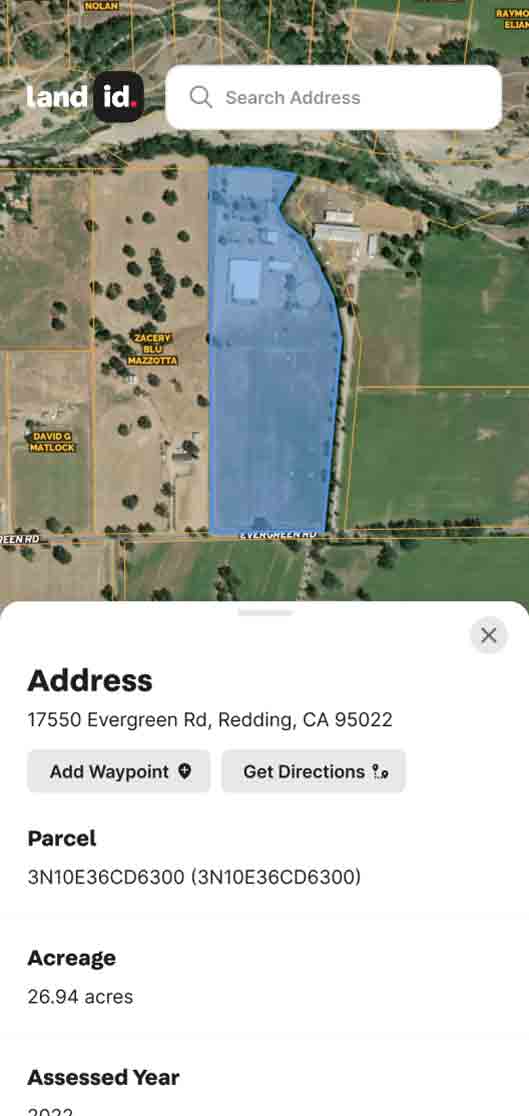
Land id® offers a comparable sales report that generates comps directly from any parcel card, on both desktop and mobile. You get up to 35 recent sales matched to your subject property's characteristics, displayed on a map and exportable as a professional PDF—no spreadsheet assembly required.
Step 5: Verify & Validate Each Comp
Raw data isn't enough. Before including a comp in your analysis, verify:
- Was it an arm's-length transaction? Exclude sales between family members, foreclosures (unless you're valuing distressed property), and sales with unusual seller concessions
- Is the data accurate? Cross-check sale price against multiple sources when possible
- Are there condition differences you can't see in the data? If a comp sold for significantly less than expected, investigate—it may have had deferred maintenance or other issues
Step 6: Document Your Sources
For every comp you use, record where you found it. This protects you if a client or appraiser questions your analysis later. Note the source (MLS, county records, Land id, etc.), the date you pulled the data, and any verification steps you took.
How to Analyze Comps & Adjust for Differences
Finding comps is only half the job. The real skill is in analysis—translating raw sale data into a defensible price recommendation for your subject property.
Calculate Price Per Unit
Start by converting each comp to a standardized metric:
- For homes: Price per square foot = Sale price ÷ Living area square footage
- For land: Price per acre = Sale price ÷ Total acreage
This allows direct comparison regardless of size differences.
Example:
- Comp A: Sold for $320,000, 1,800 sqft = $177.78/sqft
- Comp B: Sold for $295,000, 1,650 sqft = $178.79/sqft
- Comp C: Sold for $345,000, 2,100 sqft = $164.29/sqft
Make Line-Item Adjustments
When a comp differs from your subject in a meaningful way, adjust its sale price to reflect what it would have sold for if it matched the subject.
Adjustment principle: If the comp has a feature the subject lacks, subtract value. If the comp lacks a feature the subject has, add value.
Weight Your Comps
Not all comps deserve equal influence. Weight your analysis toward comps that are:
- Most similar in location and property type
- Most recent
- Required the fewest adjustments
If Comp A is two blocks away and sold last month, and Comp C is a mile away and sold eight months ago, Comp A should carry more weight in your final estimate.
Arrive at a Value Range
Professional pricing isn't about landing on a single number—it's about establishing a defensible range. Based on your adjusted comps, determine:
- Low estimate: The adjusted price of your most conservative comp
- High estimate: The adjusted price of your most aggressive comp
- Recommended list price: Where the preponderance of evidence points, typically weighted toward the middle or the most reliable comp
Common Mistakes When Using Comps
Even experienced agents make these errors. Avoid them to protect your credibility:
Using Outdated Sales
In a shifting market, a comp from 12 months ago may reflect a completely different pricing environment. Always weigh recent sales more heavily, and apply time adjustments when using older data.
Ignoring Location Nuances
Two homes a mile apart may be in different school districts, flood zones, or neighborhoods with vastly different buyer demand. Don't assume proximity equals comparability.
Over-Relying on a Single Comp
One great comp isn't enough. Appraisers typically require three to six comps minimum. If you can't find multiple comparable sales, that itself is valuable information—it may indicate a unique property that requires a different valuation approach.
Forgetting to Adjust for Condition
A comp that sold for top dollar likely showed well. If your subject needs a new roof or has dated finishes, failing to adjust for condition will lead to overpricing.
Cherry-Picking to Hit a Price
It's tempting to select only comps that support the price your client wants to hear. Resist this. Your job is accurate pricing, not price validation. Cherry-picked CMAs fall apart during appraisal.
Land Comps vs. Residential Comps: Key Differences
If you work with vacant land, rural acreage, or agricultural property, residential comp methods don't fully apply. Land valuation introduces factors that don't exist for improved properties:
Unique Factors for Land
- Access: Road frontage type (paved, gravel, dirt, easement-only) significantly impacts value
- Utilities: Available water, electric, sewer, and internet affect both value and buyer pool
- Water rights: In western states, water rights can represent a substantial portion of land value
- Timber value: Forested parcels may have merchantable timber worth a separate appraisal
- Soil quality: For agricultural land, soil type determines productive capacity and price
- Topography: Flat, buildable land commands premiums over steep or flood-prone terrain
- Mineral rights: Whether minerals convey with the sale affects value in resource-rich areas
Related: How to Price Land for Sale Using Comparable Sales
Why MLS Often Fails for Rural Parcels
MLS coverage drops dramatically outside suburban boundaries. Many rural land sales happen off-market, through local auctions, or via direct outreach. County records and specialized land data platforms become essential.
Land id's Comparable Sales Report is specifically designed to handle these scenarios—pulling sales data across county lines and filtering for acreage, land use, and location in areas where MLS data simply doesn't exist.
How Land id's Comparable Sales Report Helps Agents Work Faster
Land id's Comparable Sales Report eliminates the multi-platform juggle that eats hours from your week. Here's how it works:
One-click generation: Whether from an existing map in your account or from a brand-new property search, Land id allows you to generate a comparable sales report with a single click. The system auto-generates recent sales based on your subject property's acreage, location, and land use. Read more in our Help Center article.
Filter for accurate comps: From here, you can manually filter through the list to focus on acreage, land use, vacant land, and more, helping you build a more accurate report.
Map view with context: See where each comp sits relative to your subject property. Spatial context matters, especially for land where "comparable" often means similar terrain and access, not just similar acreage.
Professional PDF export: Generate a polished report your clients can share with family, partners, or lenders. No more copying data into spreadsheets and formatting it yourself.
Works where MLS doesn't: Land id pulls from nationwide parcel and sales data, covering rural areas and land transactions that never appear in MLS systems.
The result: Research that used to take hours, done in minutes. You spend less time hunting for data and more time advising clients.
Conclusion
Finding comps for real estate comes down to systematic research, multiple sources, and careful analysis. Start with the MLS, verify against county records, and fill gaps with specialized tools—especially for land and rural properties where MLS coverage falls short. Then analyze what you find: calculate price per unit, adjust for differences, and weight your comps based on relevance and recency.
The agents who price correctly from day one win more listings, close faster, and build reputations that generate referrals. Comps are how you get there.
Ready to pull comps in minutes instead of hours? Land id's Comparable Sales Report gives you recent sales data, pre-filtered to your subject property, with map visualization and professional PDF export—all from a single click.
FAQs
Does Land id have comparable sales reports?
Are comps the same as an appraisal?
Can I use comps for vacant land?
How do I adjust comps for differences in property size?
What's the difference between a CMA and a BPO?
See Land id In Action
Research, analyze, share, and showcase real estate, all in one place.

Continue Reading
The Different Types of Easements & How They Work

By Land id
Learn the definition of an easement, the different types of easements in real estate, how they affect property rights and value, and how to check for easements before buying property.

How to Measure Land Area on a Map Online (Step-by-Step Guide)
By Land id
Learn how to accurately measure land area on an online map for your listings with this step-by-step guide for real estate agents.

Explore Private Parcel Data & Property Boundaries
Download the Land id app and try for free.