
It’s not enough for real estate agents to have good software or analysis resources at their disposal.
What matters more is the data used to energize those products. Not long ago, they relied primarily on their multiple listing service. A single, industry-only source that was always on and required a license number to access.
The modern practice of real estate is so far from that simple era, for better and worse. Data-use practices and ownership debates have changed and flared up in the last few years, enmeshing MLSs, expanding brokerages, and consumer-facing search experiences in an ongoing and confusing melee of lawsuits, event debates, and tit-for-tat press releases.
Tech-savvy and diligent top producers are now required to spend more time vetting data partners and software vendors to ensure that what they invest in financially will deliver returns in accuracy, integrity, and reliability. This has become an expensive ancillary business function within the brokerage community and is tough to quantify as beneficial. Largely, the practice of searching for and installing data partners and enterprise vendors has resulted in brokerages juggling redundant solutions and struggling with adoption.
Now, the onset of basic LLM use has sent a collective change-up across the plate that agents are reaching for, betting their value proposition on data that’s not a guaranteed home run.
Why Real Estate Agents Turn to Consumer LLMs
Saddled by bureaucracy and member-governed funds, MLS boards simply can’t move as quickly as private, third-party vendors building productivity solutions. So, they partner with software providers in an attempt to keep agents connected, using listing data and the promise of agent access as a carrot.
The increasing data-access demands of vendor partners on MLSs only end up pulling at the thread of an already frayed relationship between agents and their associations, encouraging leadership to invoke limits on individual vendor promotion or cease data sharing altogether.
Thus, what seems like a good idea—partnering with software companies that can help members—has become an administrative nuisance for MLS leaders and in turn, their members, who are now turning to a seemingly simple, single sign-on solution: the common LLM.
The Real Estate Vibe Coder’s Dilemma
Consumer-level AI (ChatGPT, Claude, and the like) is fast. It can build helpful tools in little time and spin up sharp-looking presentations.
Speed does not equate to finality, however. Spreadsheets and decks are easy, but their content demands input and a source of authority. In higher-stakes scenarios, vetting this information results in minimal time savings.
An underlying problem is understanding the difference between data quality and data integrity. The former refers to accuracy and completeness for most use cases. Yes, your local MLS can offer data quality but without a direct partnership, the LLM is delivering a collection of reasonable assumptions drawn from a myriad of public sources.
It’s exceptionally difficult for a common user of AI to ensure that data’s integrity, regardless of how much the company behind the logo is worth. Ensuring integrity is an operation typically well out of reach for the ordinary user.
In his book, "The Real AI Guide," industry consultant Kevin Hawkins states that “the scariest AI is free.”
“That’s because in the world of free products, if you’re not paying, you are the product,” Hawkins writes.
There’s real risk in agents sharing data with untracked lineage, regardless of its starting point. That risk compounds when used to create tools for buying and selling guidance. CMAs. Offer scenarios. Listing presentations.
This makes it essential to choose AI software partners that have technical data governance mechanisms in place, conduct real-time validation, and perpetually monitor sources for changes and sourcing.
As technology opinionist Cory Doctorow wrote earlier this year, “code is a liability, not an asset. Code’s capabilities are an asset.”
Maintaining those capabilities, knowing how they fail, is not the domain of the amateur coder.
Acronym Soup: MLS & LLMs
There are close to 500 multiple listing services serving the real estate industry, each with their own data licensing standards, many serving overlapping markets. There is no national standard or single source upon which agents can rely to help their AI learn. A few larger entities have announced partnerships with LLMs, such as North Carolina’s Doorify.
However, Doorify is also on the brink of launching an internal, statewide backbone for multi-MLS data cooperation, as I reported in HousingWire, meaning agents in the Tar Heel State will have a more standardized source of truth.
FlexMLS, a major MLS software provider, has built an MCP server integration for safe LLM connection. To date, only a few of its customers are on board. United MLS is one.
“A generic LLM can summarize text, but it can’t guarantee property facts,” said Land id Vice President of AI Platform Strategy, Jeff Lutzenberger. “We bridge the gap between complex geospatial data and everyday use by providing a grounded, reproducible data foundation.”
Far too many agents rely implicitly on what their LLM is providing, which in many cases is pulling from widespread sources, such as search portal data, agent listing pages, and community data. There is no standard for ensuring it is production-ready data or that it’s providing full context for a property in its results.
LLMs & the Loss of Property Context
The missing middle here is the context, or why a property’s features matter. Walkability scores are great to know, as are school ratings and the proximity of nearby hospitals.
To truly know a property, though, is to know how those things are connected. What can a person walk to? How many intersections are between the home and the hospital? This is where average home price and days-on-market fail to tell the whole story.
For far too long, housing value was based simply on beds, baths, size, and location. Valuable, sure, but limited. Artificial intelligence can offer us additional, salient points of value. More context. This all becomes even more valuable when presented as related, dependent insights. Lot size, soil type, terrain, and slope become factors for buildability ratings. Latitude and elevation help us understand how property values intersect with weather.
There is so much more that an LLM can teach the user when powered by the right datasets and woven together by more than readily available market data.
The most compelling systems for educating the real estate consumer are those empowered by native-AI reasoning engines that can produce fully contextual narratives using data mined at the source. Physical, financial, and community insights coming together to assemble complete property stories is what separates general LLM use from a system that knows where real estate begins.
Better Property AI Starts With Better Data
AI can make property information easier to access, understand, and put to work by connecting disparate sources of information into coherent analysis, due diligence, and marketing assets.
But the quality of those solutions depends entirely on the data behind them.
For real estate professionals, that means looking beyond how quickly an AI tool produces an answer or how attractive the resulting charts make a CMA look. More importantly, where does the information come from? How current is it? Can you verify it? And does it account for the geographic and physical characteristics that make every property different?
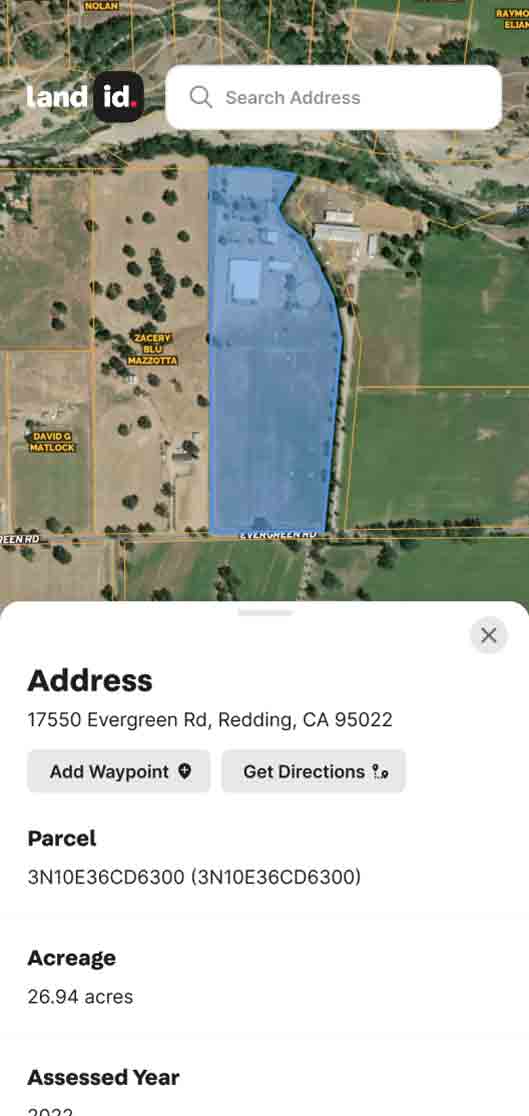
Land id believes trustworthy property intelligence starts with quality data and the context to make sense of it. That's the thinking behind Land id AI Insights, which brings disparate property data and fragmented geographic information together to help real estate professionals explore, market, and communicate property intelligence.
The ability for real estate agents to generate fast, accurate answers will be increasingly critical as AI becomes entrenched in all categories of real estate. Consumers and colleagues are adopting it, too, after all. Thus, the real differentiator will be how much confidence professionals can place in the information behind them.